
How Your Child’s Windows Might Be Sabotaging Their Sleep
Why the windows in a child’s bedroom quietly affect sleep quality, and what to check before assuming a noisy or drafty room is just “how the house is.”
Parents chasing better sleep for their kids usually look at bedtime routines, screen time, or the mattress before they ever think about the window replacement sitting a few feet from the bed. That’s a mistake, because windows do more than let in light. They regulate temperature, block (or fail to block) outside noise, and control how much early morning sun turns a dark bedroom into a 6 a.m. wake-up call.
Temperature Swings Nobody Notices Until the Room Feels “Off”
A bedroom that’s too warm or too cold disrupts the deeper stages of sleep long before it feels uncomfortable enough to complain about. Older or poorly sealed windows lose heat in winter and let heat in during summer, which means the thermostat can say 21 degrees while the air right next to a child’s bed is several degrees warmer or colder. Kids are especially sensitive to this because they can’t always articulate “I’m too hot” the way an adult would; they just wake up more, or sleep more restlessly.
Noise Leakage Is a Bigger Problem Than Most Parents Expect
Single-pane and aging double-pane windows do a poor job of blocking outside noise: passing cars, neighbors, garbage trucks, or even wind against the glass. For light sleepers, especially toddlers and younger children still building consistent sleep patterns, that noise can be enough to prevent them from reaching deep sleep at all, even if they never fully wake up.
A few signs a window is letting in more noise than it should:
- You can hear conversations or traffic clearly with the window fully closed
- The glass visibly vibrates during storms or when trucks pass
- Sound seems louder near the window than in the middle of the room
- There’s a noticeable difference in noise level between rooms with newer versus older windows
Light Control Matters More Than People Think
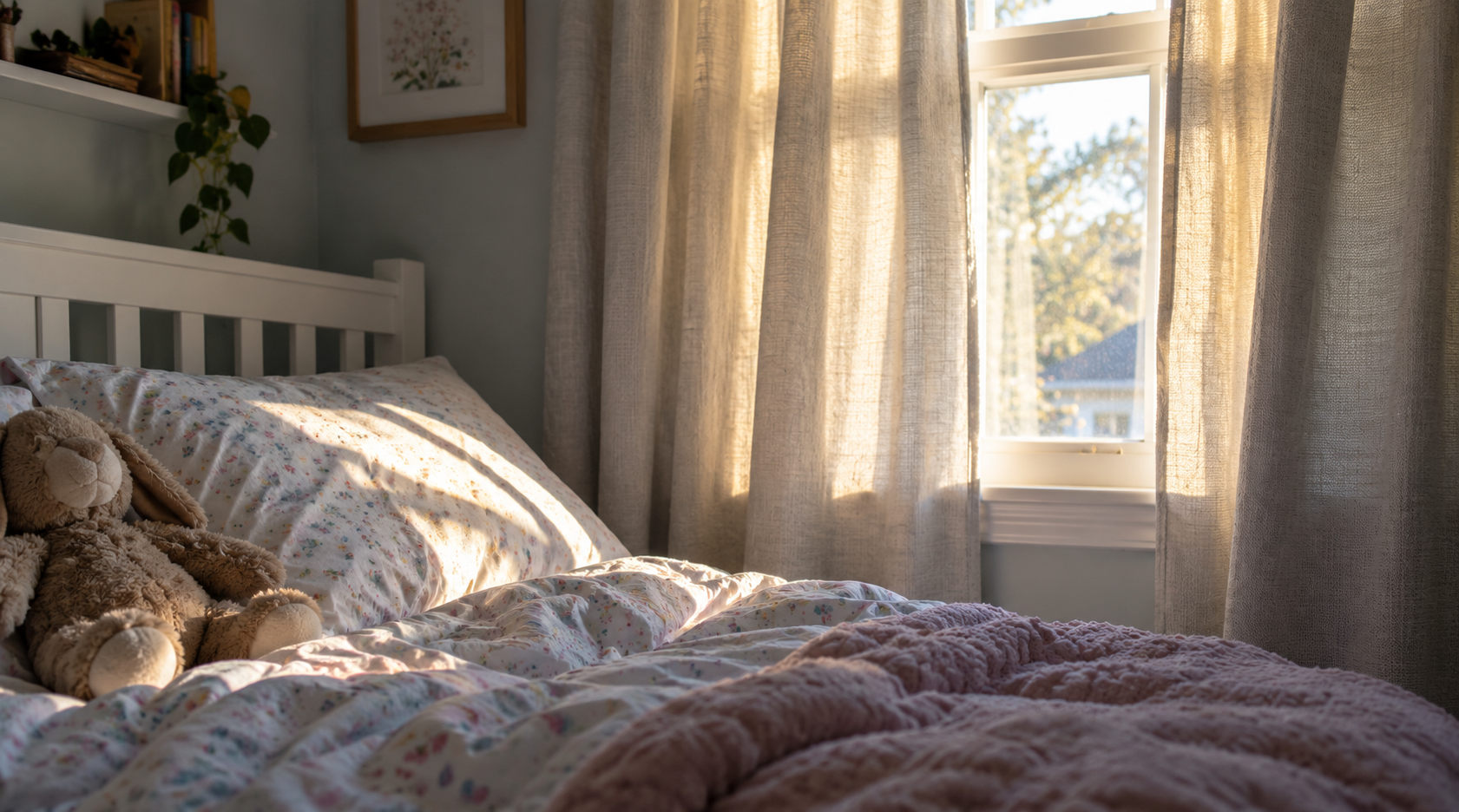
Modern life means streetlights, neighbors’ porch lights, and early sunrises in summer all competing with a child’s bedroom. Windows with poor seals or thin, low-quality glazing often pair badly with blackout curtains, because light still leaks around gaps in the frame even when the curtain itself blocks the window directly. A properly sealed, well-installed window makes blackout curtains actually work the way they’re supposed to.
Quick Comparison: What Changes With a Window Upgrade
| Issue | Older Window | Well-Sealed Modern Window |
|---|---|---|
| Room temperature stability | Fluctuates with outside weather | Stays closer to thermostat setting |
| Outside noise | Clearly audible | Significantly reduced |
| Light leakage with curtains closed | Common around frame edges | Minimal, curtains work as intended |
| Condensation on cold mornings | Frequent | Rare |
Condensation: The Sign Parents Usually Miss
Waking up to foggy or wet windows in a child’s room isn’t just a maintenance annoyance. It’s a sign that warm indoor air is meeting a cold window surface, which usually means the room is losing more heat overnight than it should. Over time, that constant moisture can also contribute to musty smells or minor mold growth near the sill, neither of which helps anyone sleep better.
What to Actually Check Before Assuming It’s “Just the House”
Before chalking up a restless sleeper to normal childhood sleep patterns, it’s worth a quick check of the bedroom window itself:
- Hold a hand near the frame on a windy day and feel for a draft
- Look for condensation or fogging between the panes, not just on the surface
- Notice whether the room temperature matches the rest of the house
- Pay attention to whether noise from outside is noticeably louder in that specific room
If several of these show up together, the window itself, not the routine, might be the thing quietly working against a good night’s sleep. It’s a small, often overlooked piece of the sleep environment puzzle, but for a lot of families it turns out to be the missing piece they hadn’t considered.
A Simple Way to Test It Without Spending Anything
Before deciding whether a window upgrade is worth it, most parents can run a low-effort test over a week or two. Track roughly when a child wakes up, how many times they stir during the night, and whether the room feels noticeably different in temperature from the rest of the house at bedtime versus in the early morning. Pair that with the draft and condensation checks above. Patterns tend to show up fast: a room that runs warmer at 6 a.m. than at 10 p.m., or one where traffic noise is audible even with the door closed, points pretty clearly at the window rather than at the child’s habits or the mattress.
It’s also worth comparing across rooms in the same house, if there’s more than one child or a guest room to check against. A meaningful difference in comfort, noise, or morning light between two rooms with different-aged windows is one of the clearest signals available, and it costs nothing but a bit of attention over a couple of nights.



Oh! I didn’t realize that our windows could actually affect our sleep too. We’ve been trying to make little changes around the house to improve our sleep quality, so this is really helpful to know. Thanks for the tip on how to check if it’s time to replace them. I’ll definitely be paying more attention to our windows now!
These are very insightful tips on where to place a child’s bed and how to regulate the room temperature. I was also thinking about the safety part of this and how windows that seem so exposed might be of concern and create anxiety for a child. Windows are important doorways, and their placement matters.
I never really thought about how much the window itself could affect a child’s sleep. The part about checking for drafts and condensation is especially useful because those are things you can notice without spending any money!
I know I need to fix the seal in one of my windows. I have double pane windows and there is moisture in between one of my windows. Unfortunately, it’s a cost that I can’t deal with a this exact moment. I need to fix the storm damage first.
Such a great post and if my rom is facing the sun…. I always find that using black out blinds or curtains can be a game changer and help not only with the light but can also help with temps too. Love this!
We always love to be dark inside our rooms, we just lit up a small lamp to at least we could see something whenever the kids have toilet emergency at night. And during summer season, we use blackout curtains, because the sun is still up even at midnight, These are great tips, thanks for sharing!
We always used blackout curtains in the kids rooms. We needed new windows, so there were definitely some issues with condensation.
My kids do have blackout curtains, and they help a ton. I have them in my room as well. I prefer a dark room, but during the day, I like it bright so I pull them back.
The noise thing is a big factor for my sleep. When my husband snores, I cant sleep.
Ugh I know we do need new windows. The ones we have are the ones that were in the house when we bought it. But we all sleep with fans, because we cannot stand outside noise.
I sleep with white noise on every night and so did my kids. It’s a great way to keep out distracting sounds and calm your mind.
Even as an adult, I have to keep every bit of light out of my room to sleep. I actually have blackout curtains.
Light is so important. Or should I say lack of light. You really want to block it out, especially for the kids.