
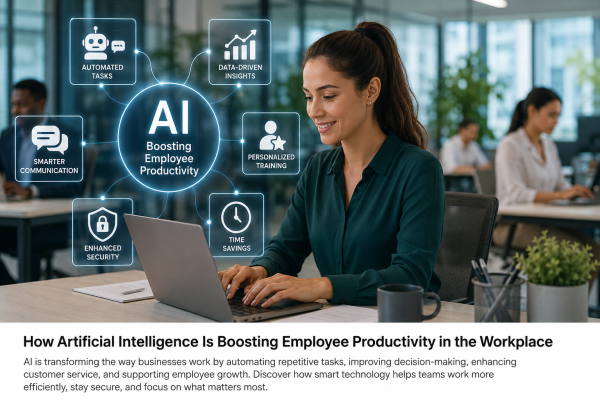
The influence of Artificial Intelligence in the Boost of Employee Productivity
Artificial Intelligence (AI) has quickly evolved from an emerging technology into an essential part of modern business operations. From automating repetitive tasks to improving customer service and supporting smarter decision making, AI is changing how organizations operate across nearly every industry.
Businesses of all sizes are discovering that AI isn’t about replacing employees. Instead, it helps workers become more productive by eliminating repetitive tasks, improving workflows, and allowing teams to spend more time on meaningful work that requires creativity, communication, and critical thinking.
Whether you’re running a small business or managing a large organization, understanding how Artificial Intelligence improves workplace productivity can help you make informed decisions about future technology investments.
What Is Artificial Intelligence?
Artificial Intelligence refers to computer systems capable of performing tasks that normally require human intelligence. These tasks may include recognizing patterns, understanding language, analyzing data, making predictions, learning from experience, and solving problems.
Modern AI powers many of the tools people already use every day, including:
- Virtual assistants
- Email filtering
- Smart search engines
- Fraud detection systems
- Recommendation engines
- Language translation
- Customer service chatbots
- Document automation
As AI technology continues advancing, more businesses are incorporating intelligent automation into their daily operations.
AI Is Transforming the Modern Workplace
Today’s workplace looks very different than it did even a decade ago. Cloud computing, remote work, collaboration software, and automation have created faster, more connected work environments. Artificial Intelligence has become one of the driving forces behind this transformation.
Rather than replacing employees, AI often works alongside them by handling repetitive, time-consuming tasks. This allows employees to focus on strategic planning, customer relationships, creative problem solving, and innovation.
Many organizations also use secure digital collaboration platforms to simplify document sharing and project management. Services such as Imprima help businesses securely manage sensitive documents while improving collaboration across teams.
Automating Repetitive Tasks
One of the greatest advantages of Artificial Intelligence is automation.
Employees spend countless hours performing repetitive administrative work such as entering data, organizing documents, scheduling meetings, generating reports, or sorting emails. AI-powered software can automate many of these activities, reducing manual effort while minimizing human error.
Automation also allows businesses to complete routine work much faster, helping employees accomplish more during the workday.
Improving Decision Making
Businesses generate enormous amounts of data every day. AI systems can analyze this information far more quickly than humans, identifying trends, forecasting future outcomes, and highlighting opportunities that might otherwise go unnoticed.
Instead of relying solely on instinct, managers can use AI-generated insights to support better business decisions involving operations, staffing, inventory, customer service, and financial planning.
Strengthening Cybersecurity
As cyber threats continue to evolve, Artificial Intelligence has become an important tool for protecting business data.
Modern AI systems monitor network activity around the clock, detecting unusual behavior that may indicate malware, ransomware, phishing attempts, or unauthorized access. Early detection allows organizations to respond faster before significant damage occurs.
Many businesses also combine AI monitoring with comprehensive vendor due diligence practices to strengthen overall risk management and improve information security.
Enhancing Customer Service
Customer expectations continue to rise. People expect fast answers, personalized experiences, and around-the-clock availability.
AI-powered chatbots and virtual assistants help businesses provide immediate responses to frequently asked questions, appointment scheduling, order tracking, and basic technical support.
When more complex issues arise, AI can quickly transfer customers to human representatives while providing relevant information to reduce wait times and improve service quality.
Making Recruitment More Efficient
Hiring the right employees requires significant time and resources.
Artificial Intelligence helps streamline recruitment by assisting with resume screening, interview scheduling, candidate communication, and application management.
Rather than replacing hiring managers, AI handles repetitive administrative tasks so recruiters can spend more time evaluating candidates and building relationships.
Some recruiting platforms also use AI to improve job descriptions, helping organizations attract stronger applicants.
Supporting Employee Training
Continuous learning has become essential in today’s rapidly changing workplace.
AI-powered learning platforms personalize training experiences by adapting educational content based on an employee’s progress, strengths, and learning style.
Instead of requiring every employee to complete identical training modules, intelligent systems can recommend personalized courses, identify skill gaps, and suggest additional learning opportunities.
This customized approach often leads to higher engagement and improved knowledge retention.
Helping Teams Collaborate
Remote and hybrid work environments have increased the need for better collaboration tools.
Artificial Intelligence improves teamwork by organizing shared documents, automatically summarizing meetings, translating conversations between multiple languages, and scheduling meetings based on employee availability.
These features reduce administrative work while helping teams stay connected regardless of location.
Improving Employee Productivity
Perhaps the greatest benefit of AI is its ability to improve productivity without increasing employee workloads.
Instead of spending valuable time searching for files, organizing data, creating repetitive reports, or responding to common customer questions, employees can focus on projects that require human creativity, strategic thinking, and communication.
This often results in higher job satisfaction because workers spend less time performing repetitive tasks and more time contributing meaningful work.
Monitoring Performance Responsibly
Some organizations use AI to monitor workflows, identify bottlenecks, and measure operational efficiency.
When implemented responsibly, these tools help managers understand where additional training, improved processes, or better resource allocation may be needed.
Rather than evaluating employees solely on output, AI analytics can identify opportunities to improve entire workflows while reducing unnecessary workload.
The Human Element Still Matters
Despite its impressive capabilities, Artificial Intelligence cannot replace qualities that make people valuable in the workplace.
Creativity, empathy, leadership, emotional intelligence, ethical decision making, negotiation, and relationship building remain uniquely human strengths that technology cannot fully replicate.
The most successful organizations recognize that AI performs best when it supports employees rather than replaces them.
Preparing for an AI-Powered Future
Artificial Intelligence will continue reshaping workplaces across nearly every industry in the coming years. Businesses that embrace AI thoughtfully can improve efficiency, strengthen security, support employees, and deliver better customer experiences.
As technology continues to evolve, organizations that invest in employee training while adopting practical AI solutions will be better positioned to remain competitive. By combining intelligent automation with human creativity and expertise, businesses can create more productive workplaces that benefit employees, customers, and the organization as a whole.