
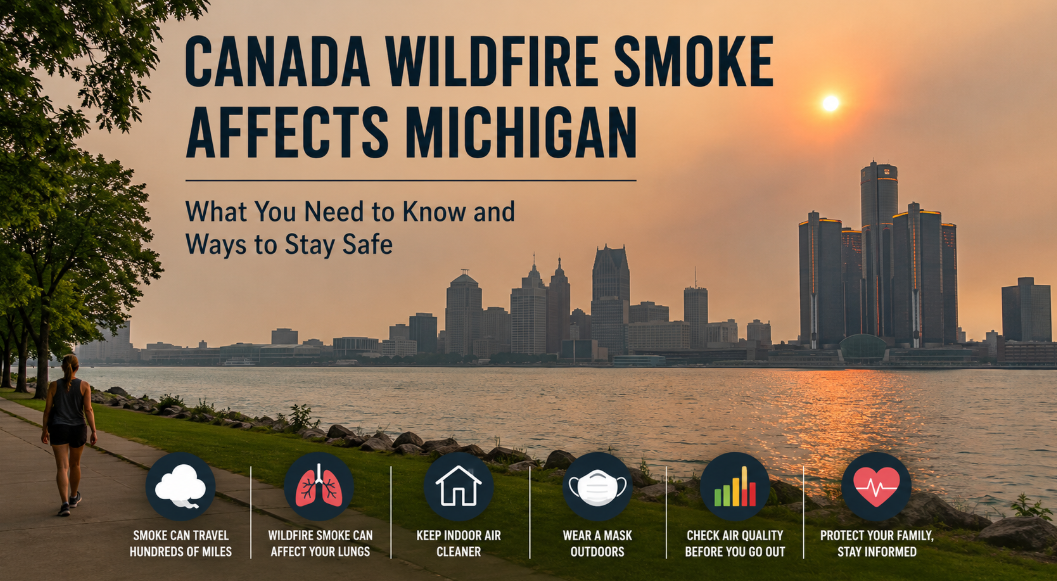
Canada Wildfire Smoke Reaches Michigan: How to Protect Your Family From Poor Air Quality
OMG, it’s so bad here from the wildfires. Looking outside across Michigan right now, many of us can see and smell that something is very different. The sky appears hazy, the air smells smoky, and visibility may be noticeably reduced. Smoke from wildfires burning in Canada and areas north of Minnesota has traveled into Michigan, creating dangerous air quality conditions throughout the state.
The Michigan Department of Environment, Great Lakes, and Energy issued a statewide air quality alert after high levels of fine particle pollution moved into the region. Local news stations, including ClickOnDetroit, have also been warning Michigan residents to limit their time outdoors and take precautions until conditions improve.
This is not simply an unpleasant smell or a cloudy summer day. Wildfire smoke contains extremely small particles that can travel deep into the lungs and, in some cases, enter the bloodstream. Everyone should reduce their exposure when air quality reaches unhealthy levels, but certain members of our community need to be especially careful.
This article is for general informational purposes and should not replace advice from a qualified medical professional. Anyone experiencing severe breathing problems, chest pain, confusion, or another medical emergency should seek immediate assistance.
How Can Smoke From Canada Reach Michigan?
Wildfire smoke can travel hundreds or even thousands of miles depending on wind direction, atmospheric pressure, temperature, and weather patterns. Although the fires may be far away, strong winds can carry thick smoke plumes southward and across the Great Lakes.
Sometimes the smoke remains high in the atmosphere and creates colorful sunsets without causing serious problems near the ground. During other events, weather conditions push the smoke closer to ground level, where people breathe it in. That is when air quality can deteriorate quickly.
The current event is especially concerning because smoke has become trapped near the ground across parts of Michigan. The haze may look like fog, but it contains fine particle pollution known as PM2.5.
What Is PM2.5 and Why Is It Dangerous?
PM2.5 refers to microscopic particles that measure 2.5 micrometers or smaller. These particles are far smaller than the width of a human hair, which makes them easy to inhale deeply into the lungs.
Wildfire smoke may contain particles from trees, vegetation, soil, buildings, vehicles, plastics, and other materials consumed by the fire. Breathing this mixture can irritate the eyes, nose, throat, and lungs.
According to the Centers for Disease Control and Prevention, immediate symptoms of smoke exposure may include:
- Coughing
- Wheezing
- Shortness of breath
- Stinging or watery eyes
- A scratchy throat
- A runny nose or irritated sinuses
- Headaches
- Unusual tiredness
- Chest discomfort
- A fast heartbeat
Even people who are normally healthy may experience symptoms when smoke levels become extremely high.
Who Faces the Greatest Risk From Wildfire Smoke?
Poor air quality can affect anyone, but some people are more likely to experience serious health complications.
The Michigan Department of Health and Human Services advises extra caution for children, older adults, pregnant individuals, outdoor workers, and people with asthma, COPD, heart disease, diabetes, or other chronic health conditions.
Children may be especially vulnerable because their lungs are still developing and they often breathe more air in relation to their body size. They may also spend more time running and playing outdoors, which increases the amount of smoke they inhale.
Pet owners should also limit strenuous outdoor activities for their animals. Short bathroom breaks are safer than long walks while air quality remains hazardous.
Check the Air Quality Before Going Outside
Air quality can change throughout the day, so never rely only on what the sky looks like. Smoke may be present even when the air does not appear especially hazy.
Visit the AirNow website or Michigan’s wildfire smoke information page to check conditions near your ZIP code.
The Air Quality Index uses several categories:
- Green, 0 to 50: Air quality is considered good.
- Yellow, 51 to 100: Air quality is moderate.
- Orange, 101 to 150: Conditions may be unhealthy for sensitive groups.
- Red, 151 to 200: Air is unhealthy for everyone.
- Purple, 201 to 300: Air is very unhealthy.
- Maroon, 301 and above: Conditions are hazardous and everyone should reduce exposure.
When levels reach red, purple, or maroon, outdoor exercise, yard work, sports practices, and recreational activities should be postponed or moved indoors.
How to Stay Safe Indoors
Staying inside can reduce exposure, but smoke may still enter through open windows, doors, and ventilation systems. Take these steps to create cleaner indoor air:
- Close all windows and exterior doors.
- Run central air conditioning with the system set to recirculate indoor air.
- Use the highest quality HVAC filter your system can safely accommodate.
- Run a portable HEPA air purifier in the room where your family spends the most time.
- Avoid burning candles, incense, or wood inside the home.
- Do not smoke or vape indoors.
- Limit frying, broiling, and other cooking methods that create additional particles.
- Avoid vacuuming unless your vacuum has a HEPA filter, because some machines can send particles back into the air.
Anyone without air conditioning who needs to keep windows closed should be careful about indoor heat. Consider spending time at an air conditioned library, community center, shopping center, or another public building with cleaner air.
What to Do When You Must Go Outdoors
The safest option during hazardous conditions is to remain indoors as much as possible. However, some people must leave for work, medical appointments, groceries, or family responsibilities.
When going outside cannot be avoided:
- Keep the trip as brief as possible.
- Avoid running, jogging, mowing the lawn, or other strenuous activity.
- Wear a properly fitted NIOSH approved N95 or P100 respirator.
- Make sure the mask seals closely around the nose and mouth.
- Return indoors immediately if breathing becomes difficult.
- Keep prescribed inhalers and emergency medications nearby.
The CDC wildfire smoke safety guide explains that a properly fitted N95 or P100 respirator can filter many of the dangerous particles found in smoke. Cloth face coverings, scarves, and loose surgical masks do not provide the same level of protection against fine particles.
Should Children Play or Practice Sports Outside?
When air quality reaches unhealthy or hazardous levels, outdoor practices, playground visits, summer camps, and sporting events should be delayed, shortened, or moved indoors.
Physical activity causes people to breathe faster and more deeply. That means a child running across a soccer field or playing at the park can inhale considerably more smoke than someone sitting quietly.
Indoor play, board games, movies, crafts, and light activities inside the home are much safer choices until the smoke clears.
When Should You Seek Medical Help?
Mild eye or throat irritation may improve after moving into cleaner air. More serious symptoms should not be ignored.
Contact a healthcare professional if you or a family member develops persistent coughing, wheezing, worsening asthma symptoms, shortness of breath, dizziness, or unusual fatigue.
Seek emergency care for severe difficulty breathing, chest pain, confusion, blue lips or fingertips, fainting, or signs of a heart attack or stroke.
Protecting Our Families Until Michigan’s Air Improves
We all love enjoying Michigan summers outdoors, but there are times when staying inside is the safest decision. Canadian wildfire smoke can move into our area quickly and remain for several days depending on changing wind and weather conditions.
Keep checking local air quality reports, close your windows, run an air purifier when possible, and avoid strenuous outdoor activities while conditions remain poor. Pay close attention to children, older family members, pets, and anyone with heart or respiratory conditions.
The smoke may eventually clear, but protecting our lungs during this event can help prevent unnecessary illness. No outdoor activity is worth risking your family’s health when the air has reached dangerous levels.




There are lots of wildfires in Europe this year too, it feels as if the world is burning up lately
I keep hearing from my American friends about how bad the air quality is because of the fires. It’s a very scary situation and I hope everyone can take care of themselves.
I’m so sorry to hear about this. I really hope they’re able to get the wildfires under control soon. My sister lives in Canada, and whenever we hear about wildfires, we can’t help but worry, especially when they’re close to where she is. Praying for everyone’s safety and hoping things improve soon.
I had no idea that wildfire smoke could travel that far, it sounds like it’s been terrible for many people. Some important tips on how to protect yourself x
We were exposed to the smoke for a few days, and it was too much for us. God help people who were hit the most; this is terrible.
I’m also from Michigan and I notice the smoke in the air. Thanks for these tips; we must protect our health in every possible way.
I can not imagine what it is like living there right now. The smoke and air qualitfy must be so scary especially for those who are suffering. I hope everyone manages to stay safe
We are at our home in Rochester, NY and when we got here, we also were affected. I have friends who just movd to Michigan from San Francisco and she has developed asthma from it. Awful
I have seen this on the news but I hadn’t realised how far the smoke from the wild fires had reached. Thank you for sharing this advice, I really hope that everybody stays as safe as possible.
Oh man, this would be tough to deal with. I am sorry for the people who have to breathe in the smoke. I know it has to be miserable.
There have been wildfires in Europe, and it’s scary how quickly they spread and take hold. Thank you for sharing the symptoms of smoke exposure; this will be useful for those affected.
Lucy | http://www.lucymary.co.uk
I can’t believe how bad the smoke has been! I can’t imagine actually living up there in the heart of it.
It’s been really crazy. Please make sure to wear your respirator Ben.
That smoke has been so terrible for so many. It came down to the Chicago area recently, and I thought I was going to die with my asthma. I had to wear a hardcore respirator.